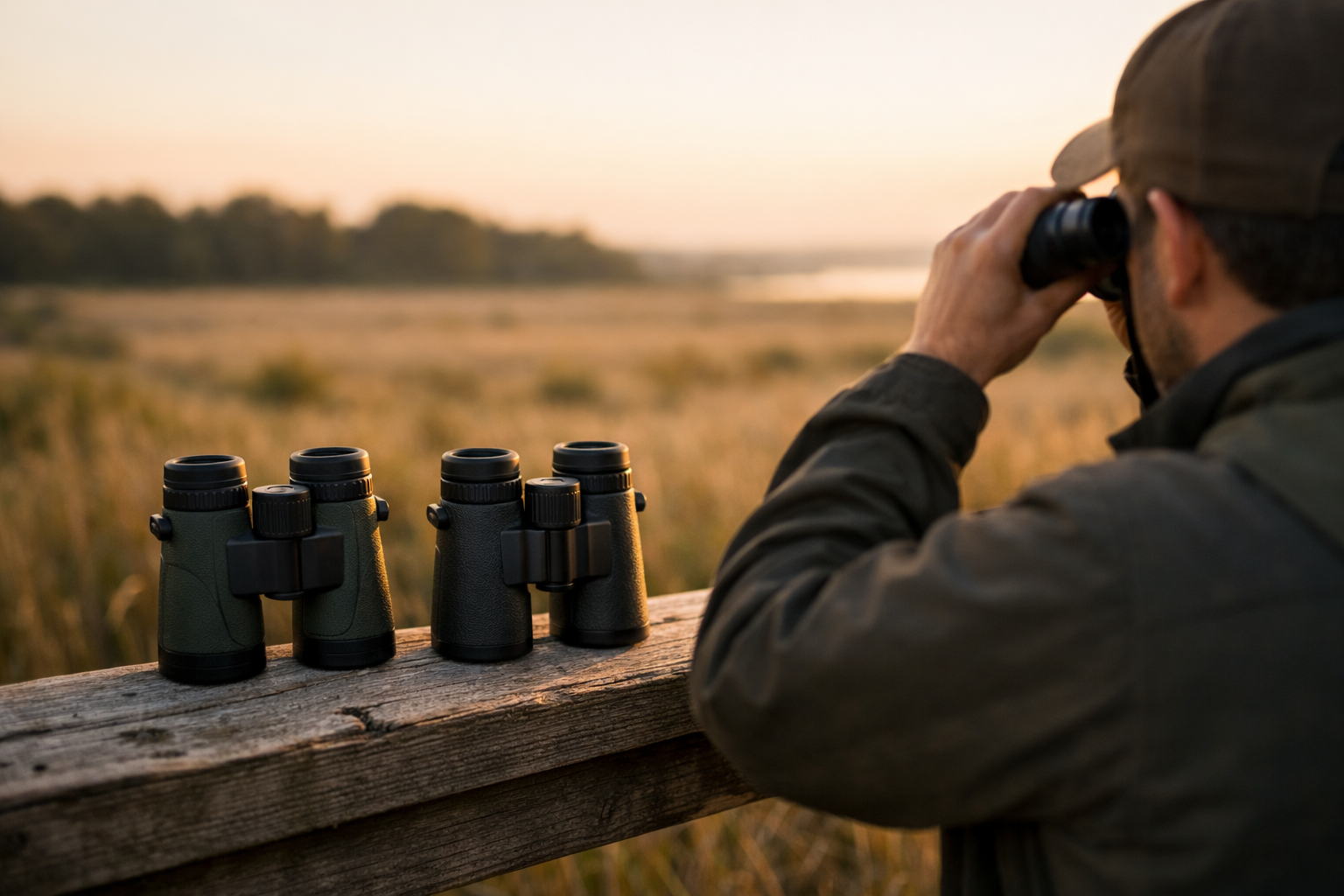
If you’ve spent any time shopping for binoculars, you’ve probably run into the same question: 8x42 or 10x42?
It’s one of the most common decisions people make when buying binoculars, and for good reason. On paper, the two look very similar. They use the same 42 mm objective lenses, they’re often offered in the same product lines, and they’re both versatile enough to handle a wide range of outdoor use.
But in the field, they can feel quite different.
For some people, an 8x42 is the easy winner. It feels steady, bright, and easy to use. For others, a 10x42 offers the extra reach they want for distant birds, open-country glassing, or picking out finer details at longer distances.
Neither option is automatically better.
The better choice depends on how you plan to use your binoculars, what kind of terrain you spend time in, and how you like a binocular to feel in your hands.
What 8x42 and 10x42 Actually Mean
The first number is the magnification.
An 8x42 makes your subject appear eight times closer. A 10x42 makes it appear ten times closer.
The second number, 42, is the diameter of the objective lenses in millimetres.
Since both binoculars use the same 42 mm objective lens, the biggest difference comes from magnification. That affects how much reach you get, but it also affects how steady the image feels and how forgiving the binocular is in real-world use.
An 8x42 typically gives you a more relaxed view. A 10x42 gives you more detail at distance, but usually with a little less steadiness.
That trade-off is really what this decision comes down to.
Why So Many People Prefer 8x42
There’s a reason 8x42 has become such a popular all-around binocular size.
For birding, general nature observation, and mixed outdoor use, it’s hard to beat. The image is usually easier to hold steady, the field of view is often a little wider, and the viewing experience tends to feel more comfortable over long periods.
That matters more than many people expect.
A binocular isn’t just about getting closer. It’s also about how quickly you can get on a bird, how easily you can track movement, and how comfortable the view feels after an hour or two of use. If you’re following a warbler through branches, scanning the edge of a marsh, or looking across a hedgerow for movement, a steady and forgiving binocular often matters more than a small jump in magnification.
This is why an 8x42 is often the safer all-around choice for:
- birders
- beginners
- general outdoor users
- people who spend long days glassing
- anyone who finds higher magnification a little shaky
An 8x42 tends to feel natural very quickly. For a lot of people, that makes it the better everyday binocular.
Where 10x42 Starts to Make Sense
That said, 10x42 binoculars are popular for a reason too.
The biggest advantage is simple: more reach.
If you spend a lot of time in open country, along shorelines, over fields, or glassing distant tree lines, a 10x42 can help you pull in more detail. That extra magnification can make a real difference when you’re trying to judge a distant bird, pick apart cover, or identify something that’s just a little farther away than an 8x handles comfortably.
A 10x42 often makes more sense for:
- open-country hunting
- hawk watching
- waterfowl viewing
- scanning fields, shorelines, and ridges
- people who naturally prefer a more zoomed-in image
The trade-off is that higher magnification also makes hand shake more noticeable. So while you gain detail, you usually give up a bit of ease and steadiness. For some users that’s no problem at all. For others, it becomes obvious the moment they lift the binoculars.
That doesn’t make 10x42 the wrong choice. It just means it suits a different style of use.
Brightness, Comfort, and Ease of View
Because both binoculars use 42 mm objective lenses, a lot of people assume they’ll look equally bright in every situation. In practice, that’s not always how they feel.
An 8x42 produces a larger exit pupil than a 10x42. In plain language, that usually means the view feels a little easier and more forgiving, especially in lower light or during longer viewing sessions.
That’s one reason 8x42 binoculars are so often described as relaxed to look through.
They also tend to be easier for quick target acquisition. If you’re trying to get on a moving bird or follow something through brush, the wider-feeling view of an 8x42 can be a real advantage.
A 10x42 can absolutely still be bright and sharp, especially in a good-quality binocular. But it usually rewards a slower, more deliberate user. If that sounds like you, the extra reach can be worth it.
So Which One Should You Choose?
Here’s the honest answer.
If you want one binocular to do almost everything well, 8x42 is usually the better place to start.
If you know you prefer more reach, spend more time glassing open terrain, or often find yourself wishing subjects looked a little closer, 10x42 may be the better fit.
A simple rule of thumb looks like this:
Choose 8x42 if you want ease, steadiness, comfort, and all-around versatility.
Choose 10x42 if you want more reach and spend more time looking at distant subjects in open landscapes.
Both are excellent formats. Neither is a mistake.
The best binocular is the one that fits the way you actually use it.
A Few Current Examples from Our Website
To make this a little more practical, here are a few examples currently listed on our website.
At the more affordable end, the Hawke Vantage HD 10x42 is listed at $259.00. It’s a straightforward option for someone who wants 10x magnification without jumping too far up the ladder.
For an accessible all-around 8x42 option, the Vortex Diamondback HD 8x42 is listed at $389.00 and includes a GlassPak harness. This is a popular format for people who want a versatile binocular for birding and general outdoor use.
If you want a stronger mid-range 10x42, the Kowa BDII-XD 10x42 is listed at $699.00. It’s a good example of a binocular that leans into detail, brightness, and a more premium viewing experience without jumping all the way into top-tier pricing.
For a premium 8x42 option, the Hawke Frontier ED X 8x42 is listed at $669.00. This size and style will appeal to people who want strong overall performance with an easier, more forgiving view.
At the high end, the Swarovski NL Pure 8x42 is listed at $4,495.00. It’s built around a very wide field of view, strong ergonomics, and a high-end optical experience for people who want the best possible performance in this class.
Pricing is accurate at the time of posting, but please contact us for the most current pricing. On some binoculars and spotting scopes, better pricing may be available if you email, call, or text us.
Final Thoughts
If someone asked us for the simplest honest answer, we’d say this:
Most people are very happy with an 8x42.
It’s easier to hold steady, easier to use, and usually the better all-around choice for birding and general outdoor use.
That said, 10x42 is still an excellent option for the right person. If you spend more time in open country or regularly want more detail at distance, it may be exactly what you’re looking for.
The key is not picking the binocular that sounds best on paper.
It’s picking the one that fits the way you actually use it in the field.