TL;DR (Too Long; Didn’t Read)
A recent comparison between the new Swarovski ST-Balance and the Kite APC 60 claimed major performance differences—but many of those claims didn’t hold up when we tested the scopes ourselves. Both stabilization systems work well, the ST-Balance is absolutely usable for birding, and several of the criticisms aimed at Swarovski were exaggerated or misleading. The APC does win on accessories and battery life, while the ST-Balance leads in optical quality. The real takeaway: both are strong performers, and hands-on testing is the only way to know which is right for you.
Once in a while, a review or comparison lands in our inbox that actually grabs our attention. Sometimes it’s because it covers a product we haven’t yet handled. Other times it’s simply a fresh perspective on something familiar. That said, we tend to ignore reviews and comparisons produced by the manufacturer or sponsored by the brand, and we approach any obviously biased piece with healthy skepticism.
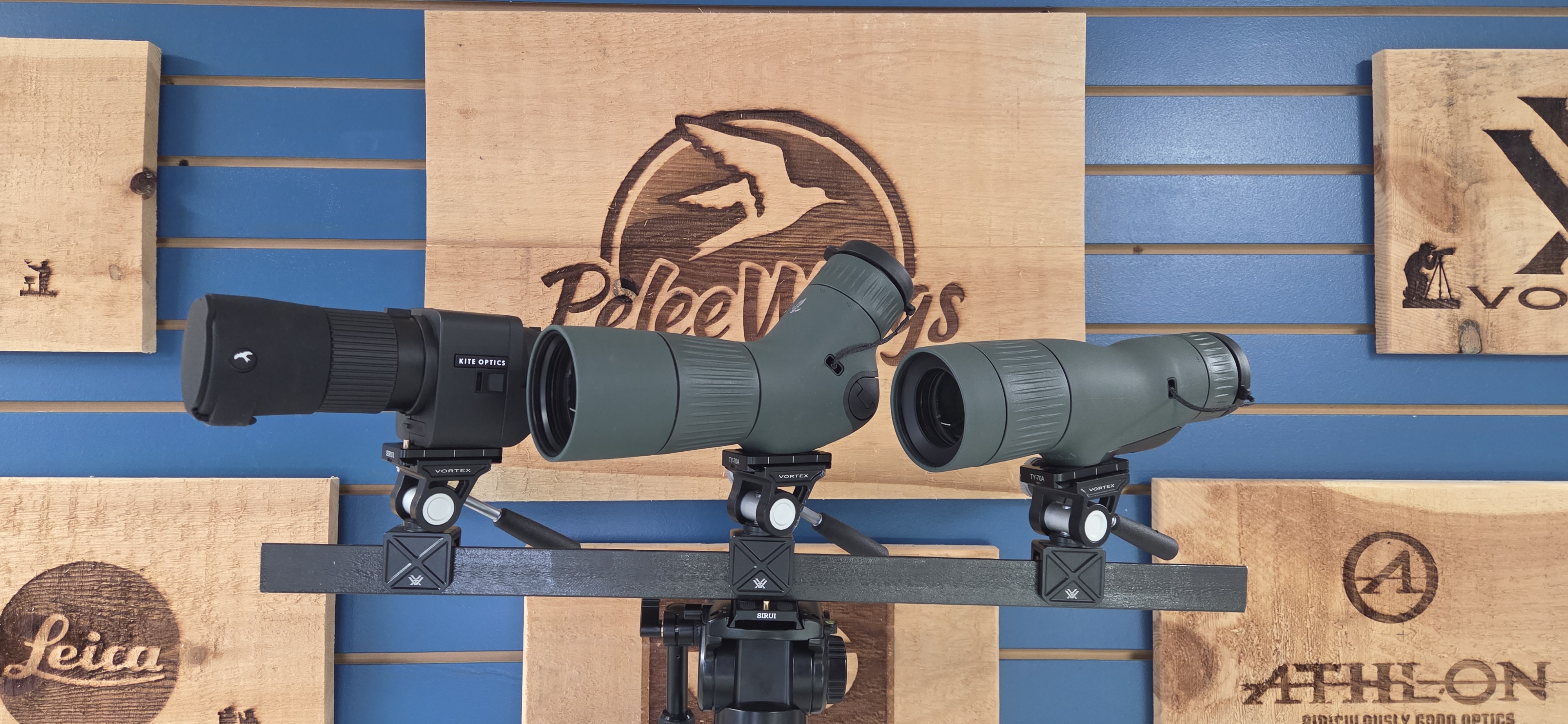
Earlier this week, a new product comparison arrived—Comparing the brand new image stabilized spotting scopes from Swarovski Optik to the APC 60 from Kite Optics. This was a comparison that we knew was coming and fully expected to be technical and informative. Instead, it turned out to be heavily biased and misleading. Here’s a rundown of what was claimed and how our findings compare. The layout I will be using is as follows.
What was bing compared
What they claim about the Kite APC What they claim about the Swarovski ST-Balance (called STB for this blog) What we found after independently testing both The comparison opens by stating: “We consider the ATB irrelevant to the comparison since 45° angled scopes are impossible to use handheld.” After spending time with the APC, ST-Balance, and AT-Balance, we’re confident that the angled AT-Balance is not only perfectly usable handheld, but no more difficult to use than any non-stabilized angled spotting scope.
Stabilization Technology
Kite APC New patented gimbal prism system with large correction angle; stable during panning, wind, boat movement, anything.
Swarovski STB Old canon style Lens-shift system with small correction angle; unstable during larger movement, limited correction angle.
Our Findings Both systems work very well, and we can’t spot a meaningful performance difference. During minor movements, the Kite system smooths the view slightly better, though it introduces a kind of “floating” sensation. The Swarovski system doesn’t smooth tiny movements quite as effectively, but it still performs beautifully—reducing shake at 35x to something closer to an 8x binocular, without that floating effect.
Focusing Speed
Kite APC Focus from close to infinity in one movement, 1 second operation
Swarovski STB Very slow; requires 8 or more re-grabs of the focus wheel. 10 second operation. Unusable for birdwatching
Our Findings This claim stopped us in our tracks. Calling the ST-Balance “unusable for birding” because of focus speed is completely unfounded. The listed 10-second close-focus-to-infinity time is accurate, but it’s also irrelevant in real-world use. With the ST-Balance’s deep depth of field, we could focus on a subject around 20 m away and then, with only about 1/8 of a turn, lock onto another subject roughly 200 m away. Rapidly focusing from 3.4 m to hundreds of meters is not a realistic field requirement, so this criticism simply doesn’t hold up.
Objective Diameter
Kite APC: 60 mm
Swarovski STB: 50 mm
Our Findings No disagreement here—the specs are correct. It’s also worth noting that the AT-Balance features a 65 mm objective. And, as we’ve said in our Spotting Scopes 101 guide, objective size isn’t everything. Glass quality has a massive impact on brightness. In our low-light tests, the Kite APC produced a brighter image, but under normal daylight, the ST-Balance was comparable in brightness and clearly superior in clarity, colour accuracy, and chromatic aberration control.
Battery Life
Kite APC: 36 hours
Swarovski STB: 12 hours
Our Findings Both claims are accurate. In our field use, each model easily lasted through a full day.
Battery Type
Kite APC: USB-C recharge
Swarovski STB: Special charger, battery needs to be taken out. No charger = no use
Our Findings This criticism feels exaggerated. The STB charger is powered via USB-C, so anywhere you can charge an APC, you can also charge an STB battery. And if the APC battery dies in the field, you’ll be waiting for a recharge—whereas the STB lets you swap in a spare.
Power Button
Kite APC: Easy, intuitive operation
Swarovski STB: Small, difficult to operate button
Our Findings We disagree. No one on our team has found the STB’s power button difficult to use or less intuitive than the APC’s switch. It is a single electronic push button. Push and hold, the scope turns on. Push and hold again, the scope turns off.
Auto Shut-Off
Kite APC: Timer function
Swarovski STB: Motion-based shut-off that only works when stored motionless
Our Findings Both systems can drain the battery if you rely solely on standby, but with 12–36 hours of life, even continuous use gets you through the day. Best practice: turn it off if you won’t be using it for a while.
Included Accessories
Kite APC: Pouch and carry system included
Swarovski STB: Neck strap only
Our Thoughts This one goes to the Kite. Including a case and carbon-fiber belly stick is a genuinely valuable add-on.
Price
Claim: The STB is 50% more expensive than the APC.
Our Findings The actual difference is closer to 45%. Optics is one of those fields where you truly get what you pay for. The ST-Balance’s superior colour accuracy, sharpness, and almost nonexistent chromatic aberration come from its high-end glass and coatings. Whether that’s worth moving from a $3,800 spotter to a $5,500 one depends entirely on the user. Our recommendation: if the ST-Balance or AT-Balance are within your budget, visit a store where you can compare them directly with the APC.
This kind of hands-on testing is where the real story lives, and it always reveals more than any biased comparison ever will.