In the world of sport optics, the goal is simple: get the brightest, sharpest view possible within your budget. And budgets can vary widely—whether you're spending $90 or $5,500, figuring out where to start can feel overwhelming.
The best way to choose your first, next, or even last pair of binoculars is to visit a store that specializes in optics. If that’s not an option, a phone call or email exchange with a knowledgeable shop can work wonders. A one-hour visit, a 30-minute phone call, or even a few emails can get you further than days of online research.
Parts
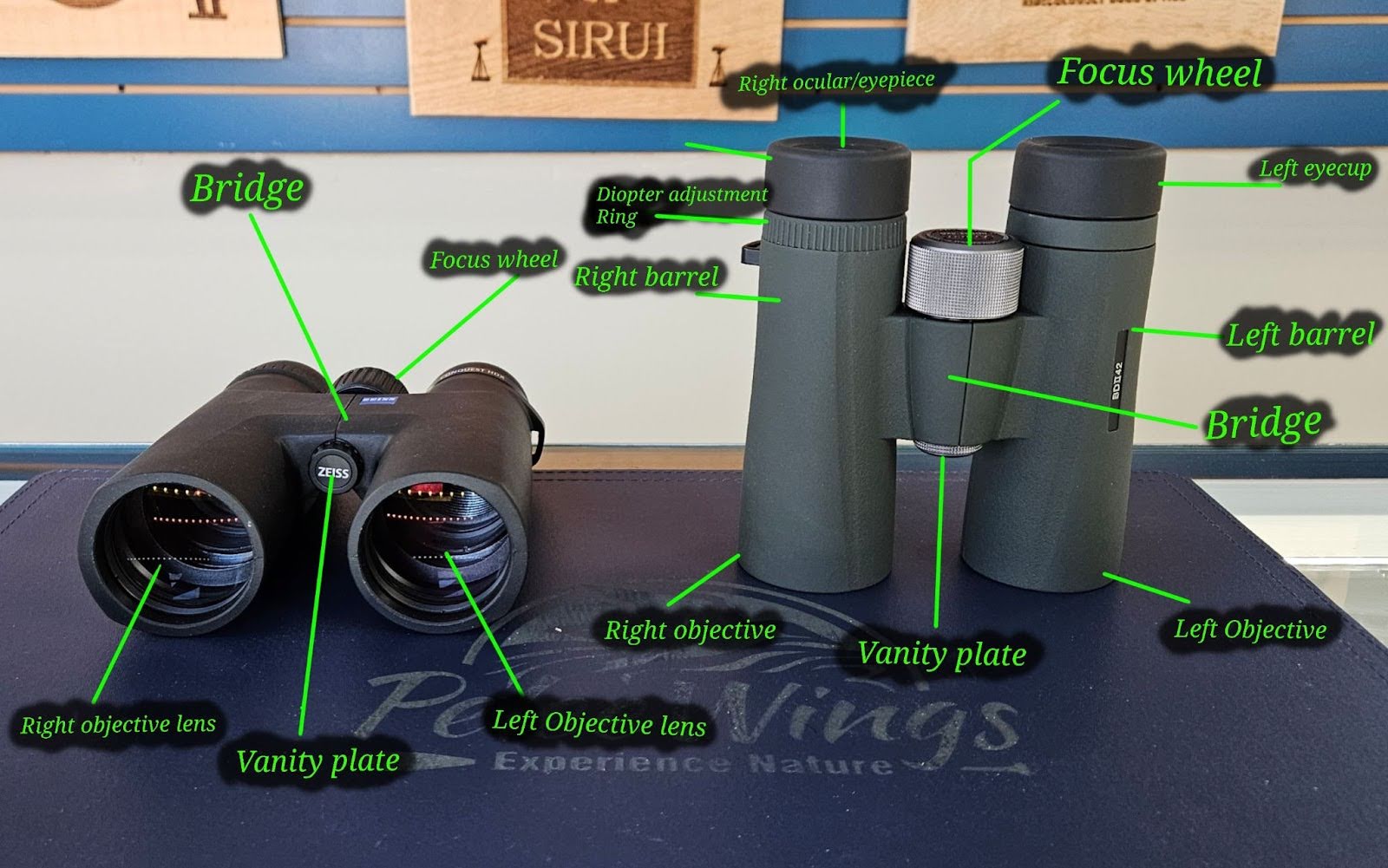
There are several key parts to a pair of binoculars. Let’s start at the front (the objective end) and work our way back to the eyecups.
Objective Lens
This is the front lens of the binoculars, where the light enters. The larger the objective lens, the brighter your view. However, a bigger lens also adds weight, so it’s a bit of a tradeoff!
Binocular Barrel
The left and right barrels house the lenses, prisms, and parts of the focusing mechanism. In lower-priced models, the frame is typically made from plastic. While this keeps costs down, it doesn’t offer as much protection if you drop your binoculars. As the price increases, you’ll find frames made from metal or lightweight alloys, which provide better durability and are often found in premium models.
Bridge
This is the middle part of the binoculars that connects the left and right barrels. Bridges typically come in three designs: the one-piece bridge (like the one shown in the pictures), the open bridge (usually seen in higher-end optics), and the double bridge, often found in pocket binoculars to allow for more compact folding. The bridge is also where you’ll find the focus wheel, vanity plate, and sometimes the diopter adjustment.
Vanity Plate
This small plate on the front side of the bridge often features the manufacturer's logo. It’s usually removable and is where you can attach a tripod adapter if you’re using one.
Focus Wheel
This large wheel is typically located at the rear of the bridge. You rotate it one way to focus on objects closer to you and the other way to focus on objects further away. In some binoculars, the diopter adjustment is integrated into the focus wheel.
Diopter Adjuster
Unless you’ve had corrective surgery or wear glasses, chances are one of your eyes is stronger than the other. The diopter adjustment helps align the focus between the two barrels to match the strength of each eye. For a detailed guide on how to adjust the diopter, check out our blog post, “Using Your Binoculars.”
Ocular Lenses (Eyepieces)
These are the lenses closest to your eyes when you're looking through the binoculars.
Eyecups
Most binoculars come with adjustable eyecups. Users who don’t wear glasses will usually find the best view with the eyecups fully extended. Those who wear glasses typically get the best view when the eyecups are fully retracted (in the shortest position).
Most binoculars have numbers printed on them, such as 8x42 or 10x32. These numbers are key to understanding how they work. The first number represents magnification (how much closer or larger your subject appears), and the second number is the diameter of the objective lens (the front lens), measured in millimeters. A larger objective lens lets in more light, resulting in a brighter image. Let’s dive deeper into what these numbers mean and how they impact your experience.
Magnification
Many people assume more magnification is always better, but that’s not necessarily true. While higher magnification makes your subject appear larger, it also has some drawbacks.
Increased Handshake
The higher the magnification, the more noticeable any shaking in your hands becomes. Most people find 8x or 10x magnification manageable, but after one too many cups of coffee or a long day, even 10x can feel hard to hold steady.
Narrower Field of View
Higher magnification reduces your field of view—the "window" you’re looking through. This makes it harder to locate and track your subject, especially if it’s moving.
Reduced Brightness
Magnification is affected by something called the "exit pupil," which is the small circle of light you see when holding the binoculars at arm’s length and looking into the eyepiece. To increase magnification without making the binoculars longer, the exit pupil gets smaller, restricting the amount of light that can exit the binoculars. Less light means a darker, grainier view, especially in low-light conditions.
Objective Diameter
Objective diameter is simpler to explain: larger lenses let in more light, while smaller lenses let in less. Every 10% increase in lens diameter allows about 75% more light into the binoculars. For example, a 42mm lens gathers 234% more light than a 25mm lens. Why not just carry binoculars with massive 100mm lenses for maximum brightness? The answer is weight. Larger lenses make binoculars heavier and harder to carry. Most people find that 32mm or 42mm lenses strike the perfect balance between brightness and portability.
Resolution
Resolution refers to the level of detail you can see, and it’s directly tied to light. Imagine trying to read the label on a box in a dimly lit room. It’s hard, right? Now flip on a light—the box hasn’t moved any closer, but suddenly you can read the label.
The same principle applies to binoculars. Two factors influence how much light reaches your eyes:
- Objective Lens Size - Larger lenses let more light into the binoculars, as we discussed.
- Glass Quality and Coatings - Not all light that enters binoculars makes it to your eyes. The quality of the glass and its coatings determine how much light is transmitted. Entry-level binoculars typically have a light transmission rate in the high 70% to low 80% range. Top-tier optics can achieve light transmission rates of 90% or more, delivering a brighter, clearer image.
Choosing the right binoculars doesn’t have to be daunting. By understanding the basics—magnification, objective diameter, and resolution—you’ll be well-equipped to find a pair that suits your needs and budget. For more detailed advice, check out our How to Choose Binoculars Guide. And remember, a little expert guidance can go a long way!