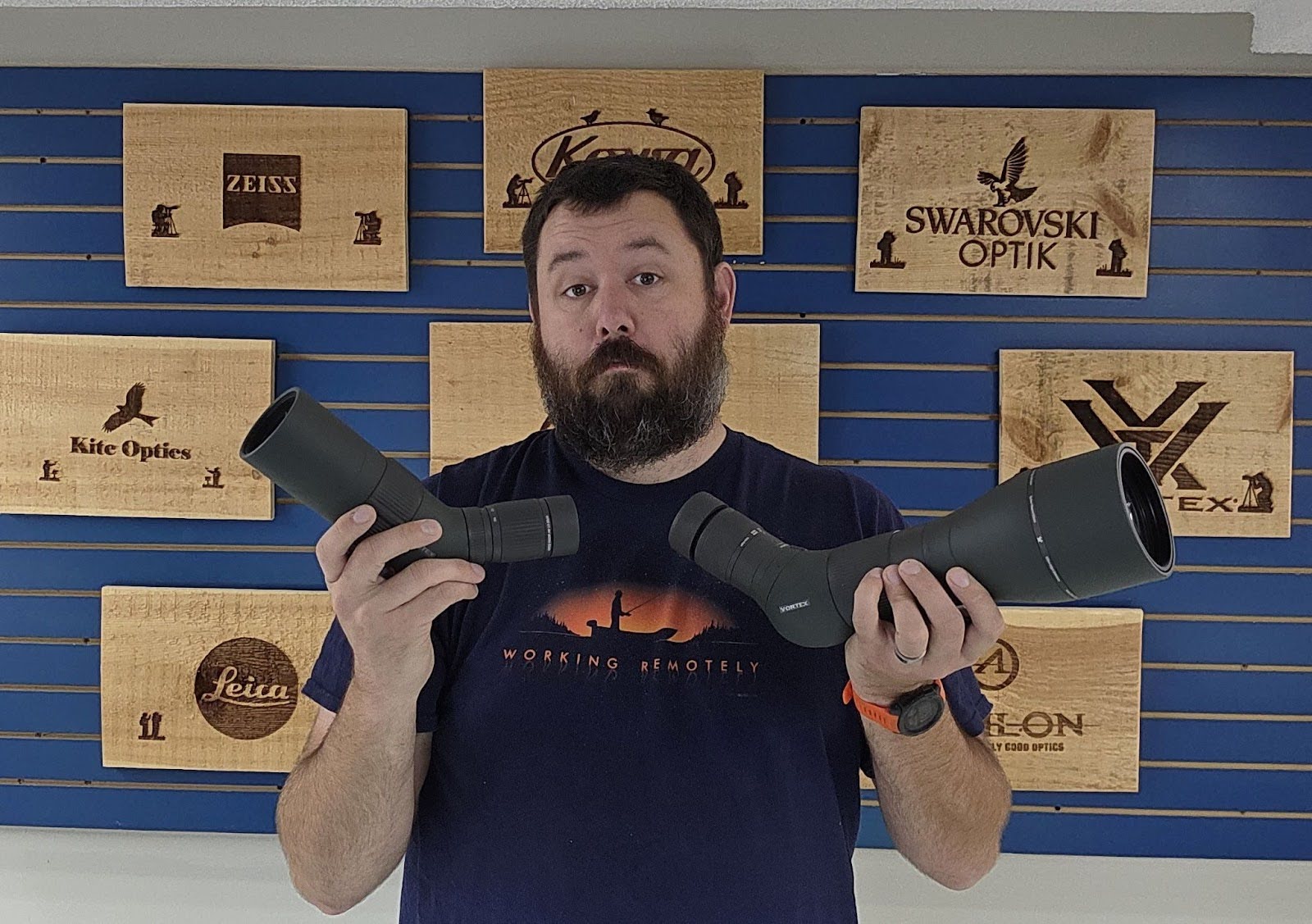
TL;DR: Bigger scopes are light-gobbling beasts that deliver jaw-dropping detail—but they’ll also weigh you down. Smaller spotters are nimble travel buddies, and mid-sized or high-end compacts give you that sweet spot between portability and performance.
Is bigger always better?
Almost.
Scopes come in many sizes! From ultra compact 50mm spotters, up to massive 115mm behemoths and every size in between but does size really matter? I am here to tell you not only does it matter, but why it matters! Aside from the very last section of this blog, I am going to make a huge assumption. I am going to make two assumptions in this blog. When comparing two scopes, we are going to compare them at the same magnifications and both scopes will be within the same model family (I will explain why later).
With most brands, all scopes in the same model family will have the same glass quality. If you read our Spotting Scopes 101, Binoculars 101, How to choose your binoculars or How to choose a scope blog, you already know that there are many different qualities of glass packed into sport optics. A scope with a larger diameter objective lens will always be brighter and sharper than a scope with a smaller lens in the same family (think Vortex Razor HD 13-39x56 vs Vortex Razor HD 27-60x85.
“But Eric, how does a larger scope allow you to see more detail?” Great question! This all comes back to light gathering ability. That is the amount of light the optic is capable of gathering. The larger the front lens, the more light that it can gather. Through some fancy math, I can tell you that the Vortex Razor 85mm spotters gather around 139% more light than the Vortex Razor 56mm (because you are dealing with surface area of a circle, it adds up fast). The whole reason that we are able to see any detail is because light is entering our eyes. If you walk into a dimly lit room, and try to read a poster on the other side of that room, it is tough to read it. But when you flip on a light switch, you can all of a sudden read it. It isnt that you got any closer (more magnification) but you are getting more light in your eyes!
So if a larger scope is always going to be brighter and sharper than its smaller brother or sister, and if you want the sharpest, brightest view possible why would they make small scopes?
Portability and Weight
Bigger is not only brighter and sharper, it is also heavier! A Razor HD 85mm weighs in at over a kg more than its 56mm counterpart! That isn’t something to scoff at! If you are a specimen of physical fitness or if your scope isnt going more than a few steps from your car or backdoor, hauling around a scope pushing 2kg for any distance may not be a big deal, but if you are watching every gram for a fly-in trip, if you are not in the best shape of your life or if you are hiking many KM per day, you may decide that sacrificing a bit of light and resolution is a worthy trade off to not have to hire your own personal sherpa.
Is there a middle ground?
Absolutely! Many scope models are available in a mid size option. Usually around 60mm or 65mm. These scopes fall smack dab in the middle in terms of weight, and optical quality and are a good option if you don't have the budget for two spotters!
The Curveball
As with everything there are exceptions! What if you don’t want to carry around a big heavy spotting scope, but still want a bright and sharp view? High end compact spotters (Think Swarovski ATC, Swarovski STC, Kowa 55a or Kowa 55s) with their top quality glass maintain their brightness in a much smaller, lighter package. They may not be quite as bright or sharp as a full size scope that is half their price, but you won't likely be disappointed!