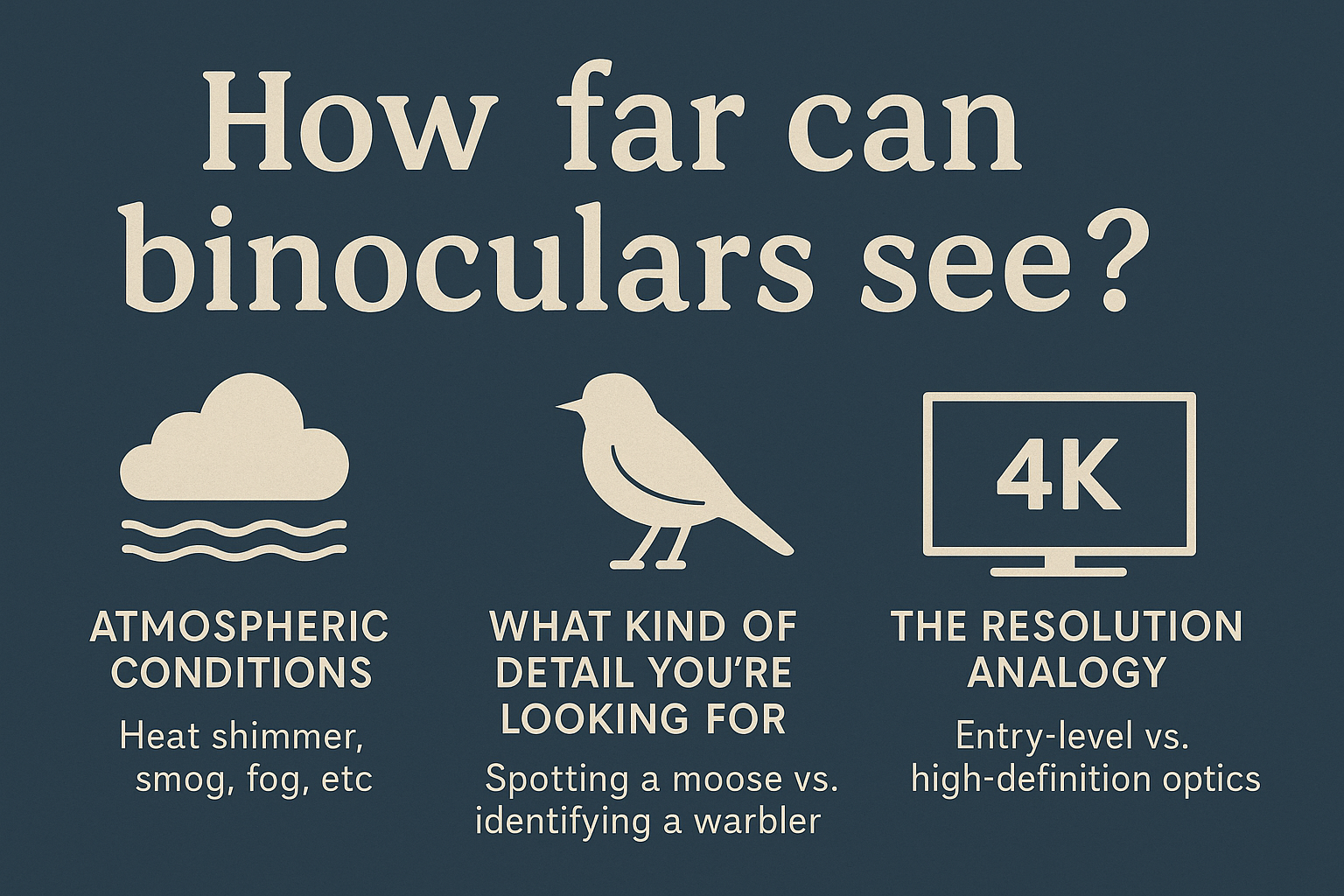
This is one of the most common questions we get — “How far can I see with these binoculars?” or “How far can I see with this spotting scope?” Well… that’s kind of a tough one. Technically, with any binoculars on the market, you can see Jupiter and Saturn — and they’re pretty far away! So yes, binoculars can see really far. But what most people are really asking is: “How far away can I see detail?” That’s a much better question — but it’s still a little tricky to answer. The amount of detail you can see depends on a few factors, like:
1. Atmospheric Conditions
Even with the best optics money can buy, there’s not much you can do about heat shimmer, smog, fog, or wildfire smoke. At a certain distance, these conditions become the limiting factor — not the binoculars.
2. What Kind of Detail You're Looking For
Are you trying to figure out whether that blob in the distance is a moose lying down in a field? Or are you trying to ID a warbler based on a small patch of colour on its wing? The finer the detail you’re hoping to see, the more important optical quality becomes.
3. The Resolution Analogy
The best way we can explain it is like this: Think of optics like TVs. At the entry level, you’re working with a tube TV. As you move up in quality, you go from 720p to 1080p, then on to 4K and even 8K. If you're looking at a ship on the lake with an entry-level optic, you’ll see that it’s a ship — maybe a person walking on deck, and some markings on the hull. But with high-end glass? That same ship, at the same distance and magnification, suddenly reveals crisp writing on the hull and the colour of the crew’s jackets. (For a deeper dive, read Binoculars 101). It’s not that the ship is any closer — your optics are just resolving more detail.
So, next time you're wondering how far a pair of binoculars can see, the answer is: As far as your eyes — and the atmosphere — will let you. But the level of detail? That comes down to the quality of the glass.