If you spend enough time around birders in southwestern Ontario, you eventually hear the same sentence:
“Just wait until May.”
They’re talking about spring migration at Point Pelee National Park. For a few weeks each year, the park becomes one of the most exciting birding locations in North America. People travel long distances hoping to experience it at least once.
And the funny thing is, the spectacle isn’t about a single rare bird. It’s about sheer numbers.
One quiet forest can suddenly hold dozens of species.
Why Birds Gather Here
The geography of the park does most of the work.
Point Pelee National Park extends into Lake Erie like a long green finger. In spring, many nocturnal migrants reach the lake near sunrise and begin looking for the nearest landfall where they can rest and refuel.
For small songbirds, long stretches of open water can be risky. There is nowhere to rest, nowhere to feed, and little shelter from the elements or predators. Because Point Pelee stretches far into the lake, it concentrates birds in a surprisingly small area.
That simple geographic advantage turns the park into one of the best migration stopover sites on the continent.
The Morning After a Big Flight
Most songbirds migrate at night. It’s cooler, often calmer, and helps them avoid many daytime predators.
By sunrise, those birds are tired and hungry. They descend into the nearest patches of forest to feed.
Some mornings you walk into the woods and everything feels normal. A few chickadees, maybe a woodpecker tapping somewhere.
Other mornings, it’s different.
You start noticing movement everywhere. Tiny shapes flick through the branches. A bright flash of yellow crosses the trail. Then another bird. Then another.
Within a few minutes, you realize the forest is packed with migrants.
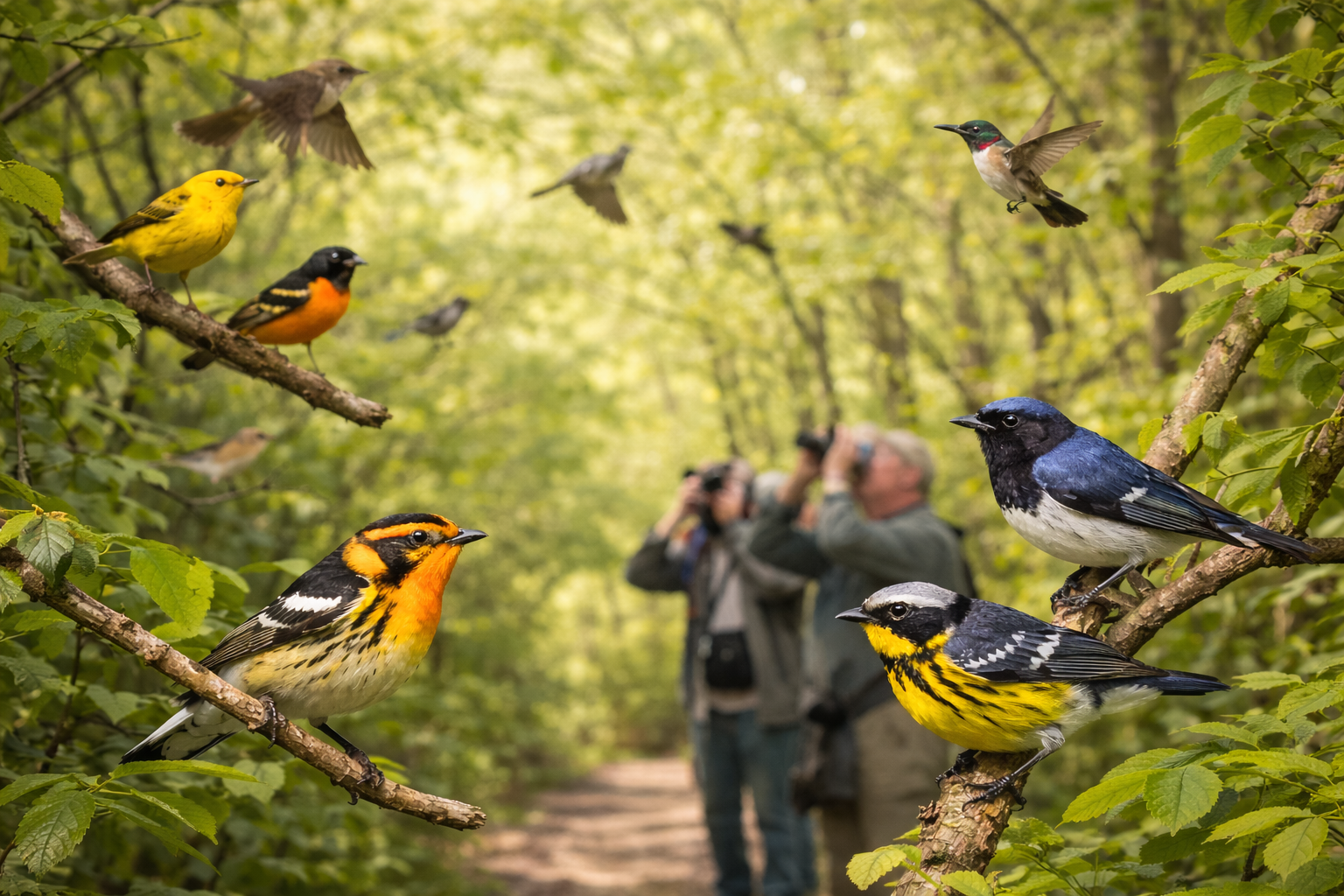
Warblers are usually the stars of the show. Species like the fiery orange Blackburnian Warbler, the striking Black-throated Blue Warbler, and the beautifully patterned Magnolia Warbler move through the canopy searching for insects.
Most of them weigh very little. Yet many have already flown hundreds or even thousands of kilometres during migration.
It’s a remarkable piece of biological engineering.
The Challenge of Seeing Them
Watching migration can be surprisingly chaotic.
Birds rarely sit still. Warblers in particular seem to bounce through branches like wind-tossed leaves. One moment they’re perfectly visible, the next they’re gone.
That’s where good binoculars make a huge difference.
Brightness helps when birds are feeding under the forest canopy in early morning light. A wide field of view makes it easier to locate fast-moving birds before they disappear again. Comfortable binoculars also matter more than people expect. During peak migration, it’s easy to spend hours looking upward into the trees.
A clear, steady view often turns a quick glimpse into a proper look.
Migration Brings Surprises
Another part of the excitement is unpredictability.
Weather plays a huge role in migration. Winds, temperature shifts, and passing weather systems can all affect how many birds stop in the park and how concentrated they become.
Under certain conditions, especially when major weather fronts collide, large numbers of migrants may be forced down into the park at once.
Birders call these rare events a “fallout,” when birds seem to appear everywhere at the same time. Trails that felt quiet the day before can suddenly feel alive with activity.
Those mornings are the ones people remember for years.
A Continental Journey in a Small Bird
Standing in the woods during migration can be strangely humbling.
That tiny warbler in front of you may have spent the winter somewhere in Central or South America. Within a few weeks, it could be nesting in the boreal forest thousands of kilometres to the north.
Migration connects ecosystems across an enormous part of the planet. The bird you see for a few seconds in Ontario is part of a journey spanning continents.
That perspective changes the way many people see birding. It stops being just about identification and checklists.
Instead, it becomes a glimpse into one of nature’s great seasonal movements.
Why People Keep Coming Back
Ask experienced birders why they return to Point Pelee every spring and the answer is usually the same:
No two mornings are ever the same.
Some days are quiet. Others feel electric. And occasionally, you step into the forest and realize you’re surrounded by birds that arrived only a few hours earlier.
Moments like that remind you how dynamic the natural world really is.
And once you’ve experienced a migration morning like that, you start looking forward to May every year.