TL;DR
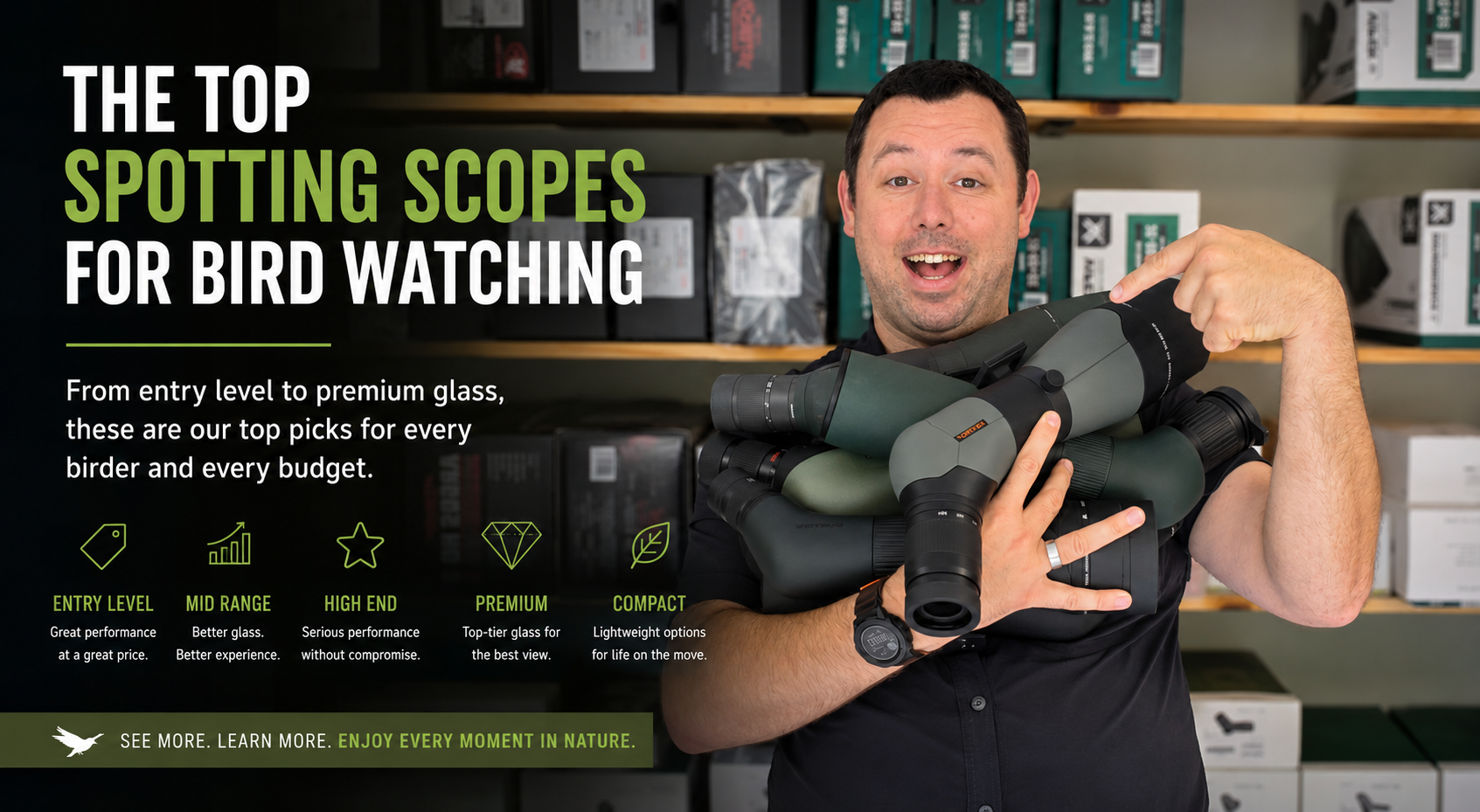
If you want the quick version, here’s how we’d break this lineup down:
- Entry level: great for birders who want a useable full-size spotting scope without spending premium money
- Mid Range: the sweet spot for a lot of regular birders who want better image quality and a more refined view without feeling like they will have to upgrade too early.
- High End: strong optical performance for serious birders who want premium-adjacent quality without going all the way to flagship pricing. This is often the sweet spot for many serious birders and hunters.
- Premium: top-tier glass for birders who want the best overall viewing experience
- Compact: ideal for birders who want to keep weight and bulk down without giving up the advantages of a spotting scope
If you’re just getting started, entry level makes sense. If you bird regularly, mid range is often where value and performance meet. If you want the best possible view, premium is where the conversation gets serious.
If you spend enough time around birders, it doesn’t take long before one thing becomes obvious: a good spotting scope can completely change the experience.
Binoculars are still the starting point for most people, and for good reason. They’re faster, lighter, and easier to use on the move. But when the bird is a long way off, when shorebirds are packed into a distant mudflat, or when you’re trying to pull detail out of a raptor sitting far out on a snag, a spotting scope starts to earn its keep in a hurry.
The challenge is that not every birder needs the same kind of scope.
Some people want an affordable full-size option that gets them into the game without wrecking the budget. Others want a serious mid-range scope that will hold up to years of regular use. And then there are birders who want premium image quality, whether that means better edge sharpness, stronger colour fidelity, or just a more relaxed view at higher magnification.
With that in mind, here’s how we’d break down some of our top spotting scope picks for bird watching.
What Makes a Good Birding Spotting Scope?
Before getting into models, it helps to step back and look at what matters most in a birding scope.
For most birders, the big considerations are:
- image quality
- brightness
- usable magnification
- size and weight
- how easy the scope is to carry and set up in the field
In general, larger objective lenses help with brightness and detail, especially early and late in the day. The trade-off is size. Bigger scopes usually perform better, but they also take up more room, add more weight, and ask more from your tripod.
That’s why there is no single “best” spotting scope for everyone.
The best one is the one that fits the way you bird.
Entry Level: A Strong Start Without a Premium Price
For birders looking to get into a full-size spotting scope without jumping straight into premium pricing, these are two very solid starting points.
Vortex Crossfire 20-60x80mm
The Crossfire 20-60x80 is the kind of scope that makes sense for someone who wants a full-size objective and practical magnification at an accessible price point.
An 80 mm objective gives you enough glass to work with for general birding, shoreline observation, and casual hawk watching, while the 20-60x range covers the kind of magnification most birders expect from an all-around scope.
This is a good fit for:
- newer birders
- backyard and local patch birders moving up from binoculars
- occasional shorebird and waterfowl watchers
- people who want a budget-conscious full-size scope
It’s not meant to go toe-to-toe with premium glass, but it gives people a real birding scope experience without making the price tag the main event.
Athlon Argos HD 20-60x85
The Argos HD 20-60x85 is another strong entry-level option, but with a slightly larger objective. That extra size can be attractive for birders who want a bit more confidence in lower light or at longer distances.
For someone shopping in this range, the Argos HD makes sense as a value-focused option that still feels like a serious field scope.
This is the sort of scope we’d look at for someone who wants:
- entry-level value
- a full-size birding scope
- a little more objective size without jumping into premium pricing
- a scope for marshes, lake edges, and open-country birding
If your goal is to get into birding with a tripod-mounted scope and stay sensible with your budget, both of these entry-level models make a strong case.
Mid Range: Where Performance Starts to Climb
This is where a lot of birders end up landing.
Mid-range spotting scopes often hit the sweet spot between price and performance. You’re usually getting a noticeable step up in image quality, better control of colour fringing, and a more enjoyable viewing experience at the upper end of the zoom range.
Athlon Ares 20-60x85
The Ares 20-60x85 sits nicely in that category for birders who want a real upgrade without heading too far up the ladder.
An 85 mm objective gives it the kind of size birders often want for serious shorebirding, waterfowl observation, and long-range scanning. It’s the sort of scope that starts to make more sense when you’re spending more regular time behind the eyepiece and want something that feels more capable in tougher viewing conditions.
Athlon Cronus 20-60x86 dual rate or barrel focus
The Cronus 20-60x86 pushes toward the upper edge of mid range and makes sense for birders who want a more refined image without jumping all the way into the higher-end categories.
This is the sort of scope that appeals to regular birders who want stronger performance, better overall refinement, and a more serious field experience than entry-level or lower mid-range models usually provide.
Hawke Endurance ED 20-60x68 or 25-75x85
Hawke’s Endurance ED line gives birders two different ways to think about the same problem.
The 20-60x68 makes a lot of sense for someone who wants a scope that stays more manageable in the field. It’s a practical middle ground between full-size performance and easier portability.
The 25-75x85 leans harder into full-size performance and reach, which can be very appealing for open-country birding, lakewatching, and situations where distant detail matters.
If you like the idea of mid-range value but want to decide whether you care more about portability or reach, this is a very useful pair to compare.
High End: Serious Performance Without Going Full Premium
This is the category for birders who want more refinement, stronger performance, and a more premium overall experience, but who still see a difference between high-end and true flagship glass.
Vortex Razor HD 27-60x85
The Razor HD 27-60x85 fits nicely into this tier for birders who want a more refined image and a stronger overall viewing experience than most mid-range scopes can deliver.
This is the kind of scope that starts to make a lot of sense for regular shorebirding, hawk watching, and long-range observation where image quality really matters. Be warned, with its 27x starting magnification field of view starts a bit narrower than some other options!
Swarovski AT Endura 21-65x75
The AT Endura 21-65x75 is Swarovski’s answer for birders who want a lighter, more accessible entry into high-end Swarovski spotting scopes.
With a body weight under 1500 g, it stands out as an appealing option for birders who want a more portable premium-adjacent scope without carrying the bulk of a full-size flagship system. That lighter weight could make it especially attractive for travelling birders, people covering longer distances on foot, or anyone who wants Swarovski quality in a more manageable package.
Premium: Top-Tier Glass for Serious Birders
This is the category where the conversation changes a bit.
At the premium end, you’re no longer just paying for magnification and objective size. You’re paying for refinement. Better detail. Better contrast. Better colour. A cleaner view when conditions get difficult. A viewing experience that feels easier on your eyes over a long day.
Kowa TSN-88
The TSN-88 has built a strong reputation for a reason.
For birders who want premium performance in a serious field scope, it’s one of the models that consistently ends up in the conversation. This is the type of scope people look at when they care deeply about image quality and want something that can handle demanding birding situations without feeling compromised.
For shorebirders, hawkwatchers, and birders who regularly glass at distance, this is the level where a scope starts to feel less like a tool you tolerate and more like one you really enjoy using.
Swarovski ATX/STX 85
The Swarovski ATX/STX 85 sits squarely in the premium category and is aimed at birders who want top-tier performance.
This is the kind of scope people consider when they want excellent overall image quality and a system that feels purpose-built for serious field use. For a lot of birders, this is aspirational glass. For others, it’s the level they buy once and plan to use for a very long time.
If your priority is simply getting the best possible birding experience out of a spotting scope, this is one of the models that deserves a hard look.
Honourable Mention: Compact Spotting Scopes
Not every birder wants to carry a full-size scope.
Compact spotting scopes give up some brightness and some of the easy comfort you get from larger objectives, but they can be a fantastic choice when portability matters more. They make a lot of sense for travel, long walks, hike-in birding, and situations where a big 80 mm or 88 mm scope feels like overkill.
Vortex Razor HD 56mm
The Razor HD 56 mm is the kind of compact scope that makes sense for birders who still want a premium feel in a smaller package.
Hawke Endurance 15-35x56
The Hawke Endurance 15-35x56 is an appealing compact option for birders who want a lighter setup and don’t need extreme magnification.
Swarovski ATC 17-40x56 (Or Orange)
The Swarovski ATC 17-40x56 has become a very attractive choice for birders who want compact size without giving up too much in the viewing experience.
If your birding often involves travel, hiking, or simply wanting to keep your kit lighter, compact scopes like these deserve more attention than they sometimes get.
So Which Type of Scope Makes the Most Sense?
If we were simplifying this into the quickest possible advice, it would look something like this:
Choose entry level if you want a real birding spotting scope at a more approachable price.
Choose mid range if you want a noticeable step up in overall viewing quality without going too far up in price.
Choose high end if you want stronger optical performance and more refinement without going all the way to flagship premium glass.
Choose premium if you want top-tier optics and know you’ll use the scope enough to justify it.
Choose compact if portability matters almost as much as performance.
That’s really the key.
A scope that looks perfect on paper can still be the wrong fit if it’s too heavy for how you bird, more expensive than you need, or bulkier than you’re willing to carry.
Final Thoughts
The best spotting scope for bird watching isn’t just the one with the biggest objective lens or the highest price tag.
It’s the one that matches the way you actually spend time in the field.
For some people, that will be a value-focused full-size scope like the Vortex Crossfire or Athlon Argos HD. For others, it will be a stronger step-up model like the Ares, Cronus, or Hawke Endurance ED. For birders looking for more refinement before going full premium, the Razor HD 27-60x85 and the Swarovski AT Endura make a lot of sense. And for birders chasing the best possible image quality, the Kowa TSN-88 and Swarovski ATX/STX 85 are right where the premium conversation begins.
Then there’s the compact category, which keeps getting more interesting for birders who want to stay lighter and more mobile without abandoning the benefits of a spotting scope altogether.
If you’re trying to decide which direction makes the most sense, the best place to start is not with brand loyalty or spec-sheet obsession.
It’s with a simple question:
How do you actually bird?
Answer that honestly, and the right type of spotting scope usually becomes much easier to find.